
Telecom Batteries for Solar: Selection Guide for Base Stations
Batteries are the backbone of any solar-powered telecom site. Without reliable storage, solar panels only provide power when the sun shines. For telecom base stations that need to stay operational 24/7, the battery bank is what keeps equipment running through the night, during cloudy weather, and through grid outages. This guide cuts through the marketing noise and looks at what actually matters when selecting batteries for solar telecom applications, drawing on field experience from deployments across Africa and Southeast Asia between 2022 and 2026.
We will cover the key differences between battery technologies for telecom solar systems, what to look for in terms of lifecycle and performance, and the practical considerations that determine whether a site stays online or goes dark. For a complete overview of integrated solar, battery, and hybrid power systems, explore the full range of telecom energy solutions available from The Solar Telecom.
Why Battery Choice Matters for Solar Telecom
Telecom infrastructure accounts for over 1% of global electricity demand, and with 5G deployment accelerating, that number is climbing. For remote or off-grid sites, batteries aren’t just backup; they are the primary power source during non-solar hours. A properly designed battery system can achieve 100% power availability with a Levelized Cost of Energy (LCOE) between $0.047 and $0.060/kWh, which sits well below typical grid tariffs of $0.087/kWh.
The wrong battery choice leads to frequent replacements, high maintenance costs, and unreliable service. In developing markets, diesel generators and lead-acid batteries have historically been the default. But operators now face volatile fuel prices, logistics challenges, short battery life (often only 2 years with daily deep cycling), and increasing pressure to reduce carbon footprints.
Lead-Acid vs. Lithium: Understanding the Options
The telecom industry is in the middle of a major transition. Traditional lead-acid batteries are being replaced by lithium iron phosphate (LiFePO4) chemistry at an accelerating pace. Here is how they compare based on real site data.
Lead-Acid Batteries
Historically, telecom sites relied on Valve-Regulated Lead-Acid (VRLA) batteries. For operators still using lead-acid, Gel technology has been a step up from standard AGM. Front-terminal Gel batteries are specifically designed for 19-inch and 23-inch telecommunication racks, offering easier installation and maintenance in cramped cabinets. These batteries use silica gel technology to eliminate acid stratification and provide better heat dissipation, making them more durable in high-temperature sites.
However, lead-acid struggles in solar applications that require daily deep cycling. A lead-acid battery bank sized for a solar site will typically need replacement every 2 to 3 years, driving up total cost of ownership. While the upfront cost is lower, the long-term economics are increasingly unfavorable.
Lithium Iron Phosphate (LiFePO4)
LiFePO4 has become the preferred choice for new solar telecom deployments. These batteries offer higher usable capacity (over 90%, compared to about 50% for lead-acid), significantly longer cycle life (4,000 to 6,000 cycles vs. 500 to 1,000 cycles), and a lifespan of 8 to 10 years that often matches the operational life of the base station itself.
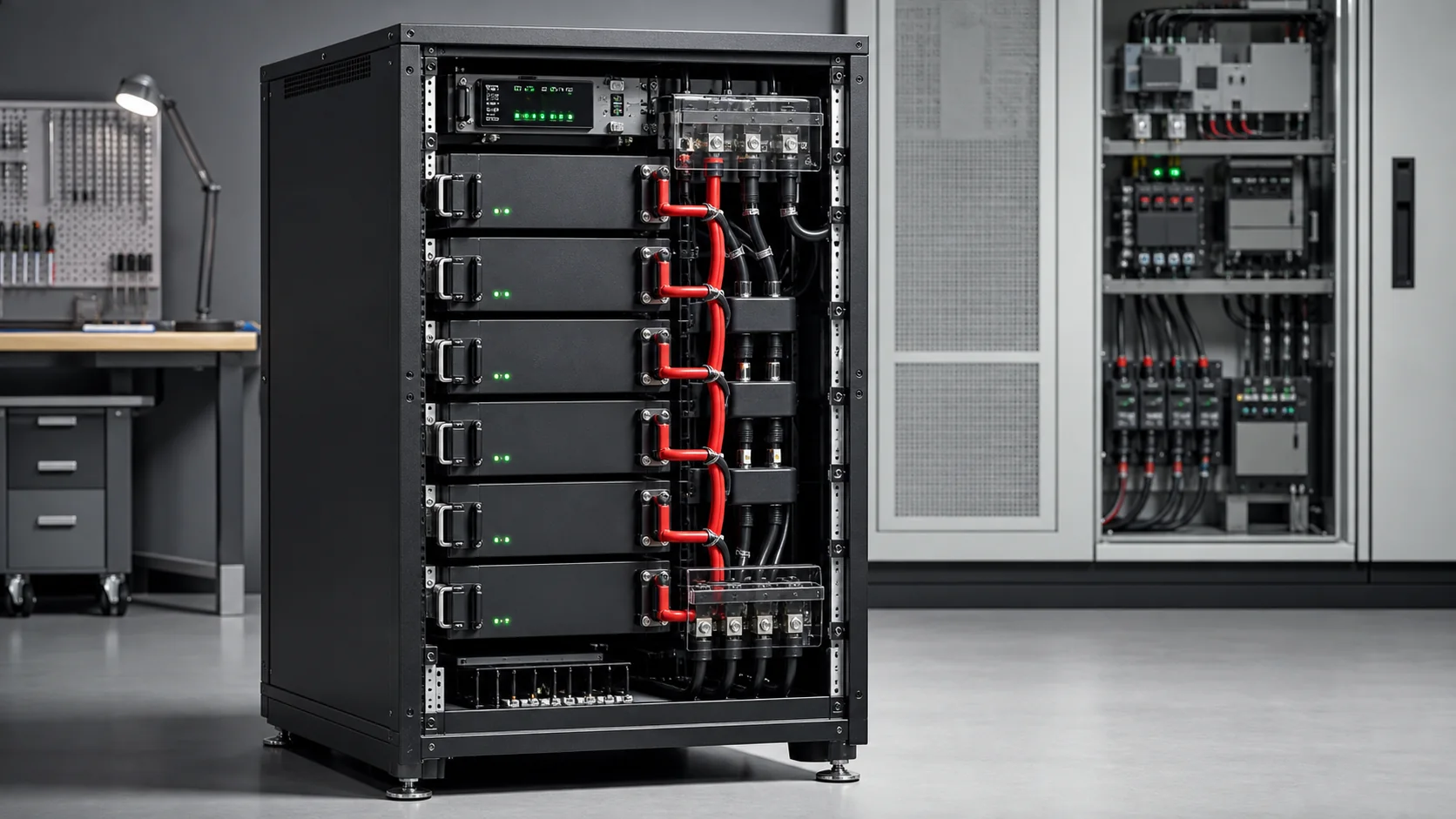
For rack-mounted installations, the 48V 150Ah LiFePO4 battery is a common choice. A 7.2kWh module can support standard telecom loads with a cycle life exceeding 4,000 cycles at 80% depth of discharge. For larger sites, modular rack-mounted systems from 50Ah to 200Ah can be paralleled to scale capacity as needs grow. These systems typically come with a built-in Battery Management System (BMS) that protects against over-charging, over-discharging, short circuits, and temperature extremes. The Solar Telecom offers a complete range of LiFePO4 battery systems designed specifically for telecom applications.
What Engineers Look For: Real-World Selection Factors
Spec sheets can be misleading. Two battery systems with the same kWh rating can perform very differently in the field. Here is what engineers with actual deployment experience prioritize.
| Factor | What to Look For | Why It Matters |
|---|---|---|
| Cycle Life | End-of-warranty capacity (e.g., 70% after 10 years) | The single biggest indicator of long-term LCOE |
| Depth of Discharge (DoD) | LiFePO4 allows 80-90% DoD vs. 50% for lead-acid | You get more usable capacity from the same nominal battery |
| Thermal Management | Active cooling, redundancy, performance in extreme temps | Heat is the enemy of battery life; proper thermal management can extend life by up to 40% |
| C-Rate Capability | Sustained C-rate (e.g., 1C charge/discharge) | Determines how quickly the battery can capture solar surge or respond to a grid outage |
| Safety Certifications | IEC 62619 (international), UL 1973 (US) | Your ticket to permitting, insurance, and regulatory compliance |
| BMS Intelligence | Cell-level monitoring, remote visibility, integration with solar inverters | Defines operational simplicity and ability to manage the system proactively |
Source: Highjoule deployment experience; NREL analysis on thermal design
Designing for the -48V DC Telecom Standard
Almost all telecom base stations operate on a -48V DC bus. This standard is critical for three reasons: safety (under 60V reduces electrical risks), corrosion resistance (negative grounding protects cable connections in humid or salty environments), and battery compatibility (four 12V batteries in series form 48V).
A solar + lithium system should be designed to maintain the -48V DC bus, allowing the site to integrate seamlessly with existing radio equipment and rectifiers. This architecture is compatible with the Indian TEC standard for telecom solar photovoltaic power supplies, which covers 48V DC systems handling loads up to 20A continuous or 480Ah daily.
When the system also includes grid power, a hybrid architecture can achieve 100% availability while optimizing costs. The optimal configuration of solar PV, battery storage, and diesel generation depends on site-specific parameters including load profile, grid availability, and local resource costs.
Environmental Adaptability
Telecom base stations are deployed in some of the harshest environments on earth. Battery systems must be designed to operate reliably under extreme conditions:
- High temperatures and humidity: Look for IP55-rated cabinets and coated circuit boards.
- Coastal salt spray: Use stainless steel and sealed components.
- Extreme cold (below -40°C): Some LiFePO4 systems offer optional battery heating.
- High altitude (above 3000m): Derating of power components is necessary.
- Frequent lightning: AC and DC surge protection is essential.
Thermal management is particularly important. According to NREL analysis, proper thermal design can extend cycle life by up to 40%. A battery container that cannot manage its heat in a hot climate will throttle its output or fail prematurely. When comparing systems, look for active liquid cooling vs. forced air, and check for redundancy in the cooling system.
Safety and Standards
Safety is non-negotiable. A battery system holding hundreds of kilowatt-hours of energy is a potential hazard if not built with meticulous care. Compliance with established standards is your best hedge against risk.
Key standards to demand in any procurement specification include:
- IEC 62619: Safety requirements for secondary lithium cells and batteries, covering industrial applications including telecom.
- UL 1973: Batteries for use in stationary, vehicle auxiliary, and light electric rail applications.
- UL 9540: Energy storage systems and equipment.
Don’t just ask if a system is “certified.” Ask for the specific certification reports. The difference between a system that merely contains batteries and one designed for 20-year duty in a telecom environment is in the manufacturing standards that govern its construction.
A smart Battery Management System (BMS) is also critical. Without a well-manufactured battery, a BMS is a smart doctor with a terminally ill patient. With a well-made battery but a basic BMS, you have a healthy athlete with no coach. The synergy is essential. The manufacturing standards ensure the physical integrity of the cells, while the BMS, built to the functional safety mandates within these standards, acts as the 24/7 monitoring system.
Thinking in LCOE: Cost Optimization
When evaluating battery options, it’s essential to look beyond the initial purchase price. A cheaper lead-acid battery will have a higher Levelized Cost of Energy (LCOE) over its lifecycle due to more frequent replacements, higher degradation, and greater maintenance costs. A robust LiFePO4 system, with its longer life and deeper usable capacity, often delivers a better long-term return despite a higher upfront cost.
LCOE analysis should factor in the following:
- Upfront CAPEX per kWh
- Expected cycle life and degradation curve
- Operating and maintenance costs
- Fuel savings (for hybrid sites with diesel generators)
- Revenue opportunities (e.g., grid services for connected sites)
A well-designed solar + LiFePO4 system is a long-term investment in site availability and operational efficiency. The transition to lithium is already the global standard for reliable, off-grid telecom infrastructure, particularly in sunny regions across Africa, Southeast Asia, and Latin America.
About the author
This article was prepared by the technical team at The Solar Telecom. We have been designing, integrating, and deploying solar, battery, and hybrid power systems for telecom infrastructure since 2012. Our team has worked with operators including Airtel, MTN, Telkom, and multiple TowerCos across 150 countries. We handle everything from site assessment through to commissioning and maintenance.
Disclaimer: This article is for informational and planning purposes. The content is based on publicly available research and practical experience. Project-specific engineering design and equipment selection should be performed by qualified professionals with appropriate site data. Regulatory and technical references are current as of the date above; please verify with relevant authorities and standards bodies before procurement.


